


Immunoaffinity Purification of Methylarginine Proteins/Peptides by Protein A Sepharose
By: Daniyal Kashif
Protein affinity purification
Protein A Sepharose is an affinity resin that is widely employed for the selective enrichment of immunoglobulin G (IgG) and its various subclasses from horse, rabbit, or human antiserum. More specifically, this purification technique involves the covalent immobilization of Protein A—extracted from the pathogenic bacteria Staphylococcus aureus—onto activated porous beaded agarose (trade name ‘Sepharose’). Since Protein A has a strong affinity for the fragment crystallizable (Fc) region of IgG (but not the fragment antigen binding [Fab] region), it acts as a ligand in the presence of these antibodies and binds to them reversibly, allowing for purification of IgG in solution after cross-linkage and elution. Furthermore, such affinity resins can also be cross-linked with a purified IgG antibody to facilitate enrichment of a target antigen from cell homogenates and other biological extracts.
Cellular protein arginine methylation
Arginine methylation is a ubiquitous and stable post-translational modification (PTM) that is catalyzed by the protein arginine methyltransferases (PRMTs) family of enzymes. PRMTs methylate glycine/arginine-rich (GAR) motifs within their substrates by transferring a methyl group from S-adenosyl methionine (SAM) to the guanidino nitrogen of arginine. Cellular targets of PRMTs in mammals include histones, hnRNPs, nucleolin, and fibrillarin among many other nuclear and cytoplasmic proteins. As such, methylarginine proteins are relevant in the context of various cellular pathways and also implicated in many disease processes, making them important biological targets for translational research in the field of protein methylation. The isolation of said proteins from different biological systems for downstream biochemical analysis can be achieved by the use of protein-specific antibodies and Protein A Sepharose.
Application of conjugated affinity resins
The formation of antibody-antigen complexes immobilized on Protein A Sepharose can be employed for the detection of methylarginine proteins/peptides from biological extracts using our commercially available and highly specific anti-asymmetric dimethylarginine (anti-mRG) rabbit polyclonal antibodies. Additionally, such assays can be complemented with our anti-RG polyclonal antibodies—which are raised against the identical primary peptide sequence as anti-mRG but without any methylation—to control for cross-reactivity to non-methylarginine epitopes.
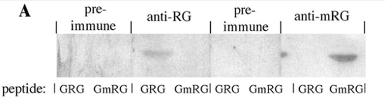
Figure 1. Specificity of antisera raised against glycine-arginine (GRG) and glycine asymmetric dimethylarginine (GmRG) peptides. (A) 16-mer GRG and GmRG peptides were committed to SDS-PAGE and immunoblotted for reaction with antisera. Pre-immune sera taken from animals prior to immunization with GRG and GmRG peptides don’t bind to either peptide. Anti-RG (1:1000 crude serum) binds to only the non-methylated RG peptide; anti-mRG (1:1000 crude serum) recognizes only the methylated form of the immunizing peptide. Adapted from Duan et al.
Benefits of immunoaffinity resins
Similar to non-conjugated resins, IgG cross-linked Protein A resins are also reusable across identical samples for peptide/protein immunoaffinity purification when stored in suitable reagents (e.g., PBS + 0.02 % sodium azide). In micro-scale experiments, this reusability obviates the need to co-elute antibodies with the target peptide/protein, thus making agarose resins cost-effective.
To explore more general applications and case studies of our products, as well as hear the latest news in the field of protein methylation, make sure to stay updated with our blog. You can also browse our diverse catalog of cell lines (including HEK293, HeLa, E0771), expression vectors, antibodies (trial size available), and etc. for all your research needs. Contact us today to place your order or to request more information.
